
Brazilian Entrepreneurs Gathers Leaders During A Defining Brazil-U.S. Business Week
Hosted by Experience Club US and G4 Educação, the luncheon was part of Brazil Week, which brought together entrepreneurs, investors, banks, funds, and institutional representatives around the traditional Person of the Year agenda.

New York became the center of one of the most intense weeks on the Brazil-U.S. business calendar. During Brazil Week, the city hosted more than 20 events focused on business, investment, institutional relations, financial markets, technology, and international expansion.
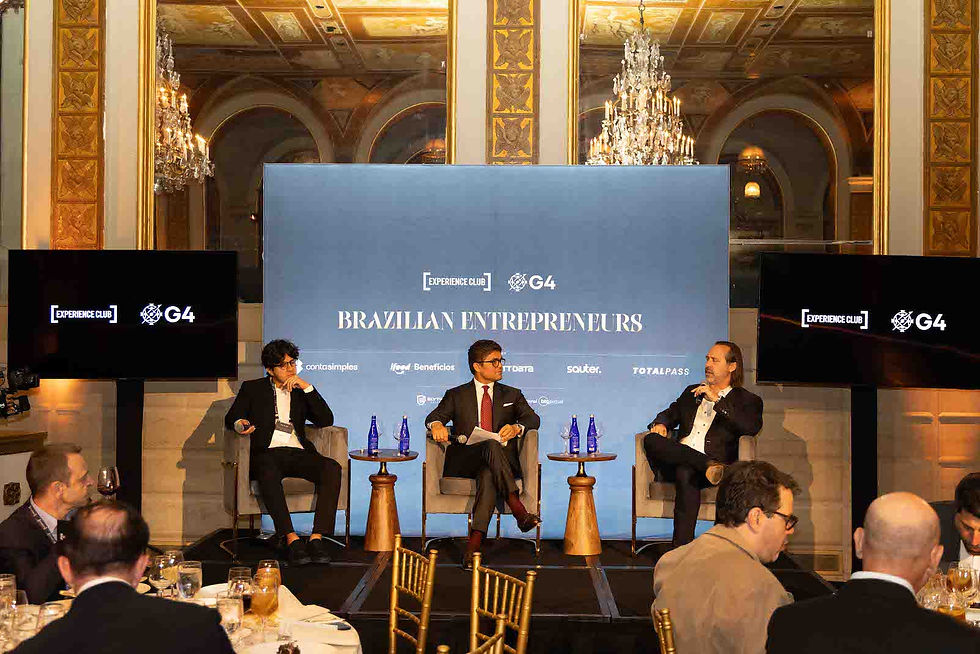
In this highly competitive environment for attention and high-level presence, Brazilian Entrepreneurs, hosted by Experience Club US in partnership with G4 Educação, gathered 244 participants for a luncheon at The Plaza Hotel, in Manhattan. The event was part of a week also marked by the traditional Person of the Year gala dinner, hosted by the Brazilian-American Chamber of Commerce, one of the key moments in the Brazil-U.S. business agenda in New York.
The audience reflected the broader profile of Brazil Week itself: business leaders, investors, C-level executives, financial market representatives, family offices, and entrepreneurs active in or looking at opportunities between the two countries. In a week with multiple events taking place simultaneously across Manhattan, both the number of participants and the profile of the room reinforced the relevance of Brazilian Entrepreneurs within the broader agenda.
For Marcelo Goulart, CEO of Experience Club US, the scale and profile of the audience stood out even more because of the density of Brazil Week’s agenda.
“What stood out the most was the context of the week itself. There were so many major events happening, with practically Brazil’s GDP present in New York, that the competition between one event and another was intense. It is very hard to compete in the middle of such a crowded agenda,” says Goulart.
The panel connected the political and economic shifts underway in the U.S. with the rise of artificial intelligence as a new frontier for investment, infrastructure, and corporate strategy. Participants included Chris Buskirk, co-founder of Rockbridge alongside JD Vance and an influential voice in the American conservative movement; and Victor Lazarte, founder of Wildlife, a company that reached more than 2 billion users. Lazarte was also the first Brazilian to become a partner at Benchmark, one of Silicon Valley’s most respected venture capital firms, and now leads his own fund focused on large-scale AI investments.
“What impressed us was not only the content, although that was very strong, or even the fact that The Plaza is a New York classic. It was literally the fact that we managed to put Brazil’s business leadership in one room, with 244 people. Considering how competitive the week was, that was certainly the highlight of the event,” he adds.
AI and Brazil’s Role in the New Global Infrastructure
For Flavio Pripas, partner at Experience Club US, the gathering reflected the Brazilian business community’s ability to mobilize in New York and placed a strategic topic for the future of the economy at the center of the conversation: Brazil’s role in the new global infrastructure of artificial intelligence.
“Brazil now has the chance to embrace an opportunity: to become one of the places for the development of data centers focused on AI inference, using what the country has best,” says Pripas.
The discussion was based on a reading of Brazil’s structural assets amid the global race for computing capacity. As artificial intelligence advances, major technology companies are increasing investments in infrastructure, energy, connectivity, and data centers. For Pripas, the country can play a relevant role in this new geography, as long as it can combine its natural resources with a competitive regulatory environment.
“Brazil exports commodities — soybeans, iron ore, maybe some oil — but it is also very abundant in land, water, and space. With the right regulatory environment, it could attract a significant share of the investments that major companies are now making in AI data centers, also taking advantage of its proximity to the United States and this integration of the Americas,” he says.
The gathering gave concrete shape to a topic that often appears in abstract terms in the technology debate: how Brazil can position itself in the new global geography of artificial intelligence, at a time when flows of capital, energy, and digital infrastructure are being reorganized.


Comments